
A beautifully tiled bathroom can still feel underwhelming when the lighting is flat, harsh or poorly positioned. The strongest bathroom lighting ideas do more than make a room brighter: they make the morning routine easier, show finishes at their best and create a calmer setting at the end of the day.
For a high-quality bathroom renovation, lighting should be considered at the planning stage rather than treated as a finishing detail. The position of a mirror, the height of a vanity, available natural light and the way your household uses the room all influence the right solution. A thoughtful scheme balances practical clarity with the relaxed, polished atmosphere homeowners expect from a finished space.
Bathroom lighting ideas begin with layers
One central ceiling fitting rarely delivers the comfort or flexibility a bathroom needs. It may illuminate the room generally, but it can leave shadows across the face, make a compact layout feel stark and give little control over the mood.
A layered plan resolves this by combining ambient, task and accent lighting. Ambient lighting provides the overall level of brightness for entering, cleaning and moving safely around the room. Task lighting supports detailed activities at the basin, such as shaving, skincare or applying make-up. Accent lighting is the quieter layer that adds depth, highlighting a niche, joinery detail or feature tile once the practical work of the day is done.
The proportions depend on the room. A family bathroom may need more confident general illumination and durable task lighting, while an en-suite can favour softer, more intimate layers. In both cases, the goal is the same: every light should have a clear purpose.
Get mirror lighting right first
The basin is where poor lighting is noticed most quickly. A downlight directly above a mirror often casts a shadow beneath the eyes, nose and chin. It can be adequate for general brightness, but it is rarely the most flattering or useful source on its own.
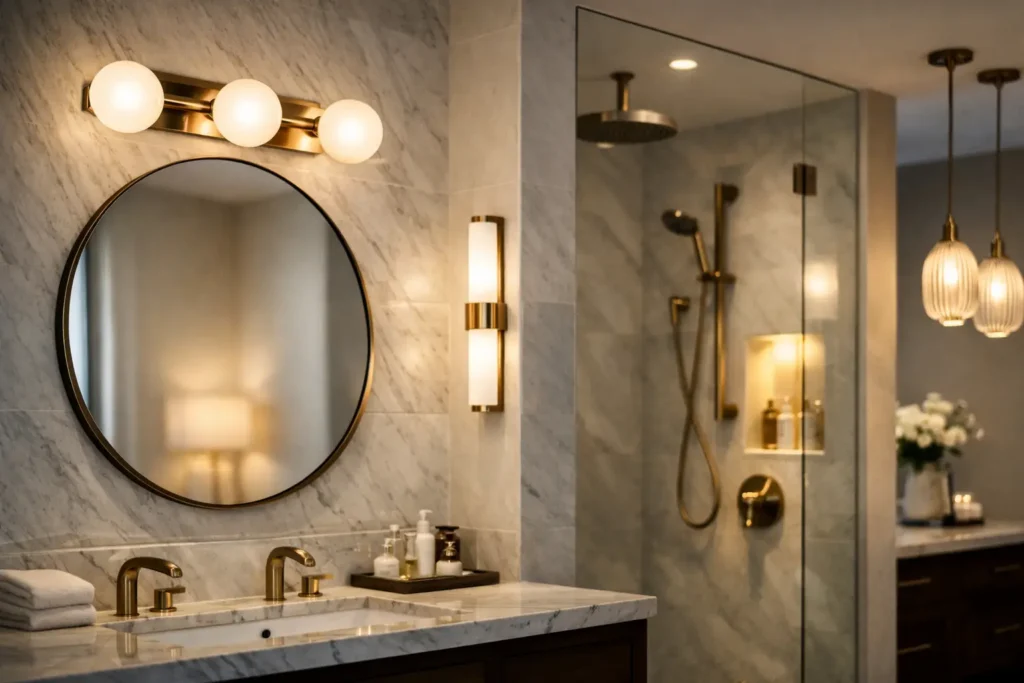
Vertical fittings positioned to either side of the mirror give more even illumination across the face. They can take the form of slim wall lights, integrated illuminated mirrors or discreet linear LEDs concealed within a mirrored cabinet. A broad, evenly lit mirror is particularly effective in London bathrooms where the room may be compact and natural daylight limited.
Integrated mirrors offer a clean, contemporary look and can reduce visual clutter. However, separate wall lights give greater freedom to choose decorative finishes and replace fittings later. If you are selecting a large statement mirror, side lighting is often the more refined choice because it allows the mirror itself to remain a focal point.
Choose a fitting with a diffuser rather than exposed point-source LEDs where possible. Diffused light is kinder on the eye and avoids the dotted reflection that can distract from an otherwise premium finish.
Consider colour temperature and colour rendering
The warmth of the bulb changes how every surface appears. Light around 2700K feels warm and restful, making it well suited to a bathroom designed for unwinding. Around 3000K remains warm but offers a little more crispness for daily routines. Cooler white lighting can appear clinical beside natural stone, timber-effect finishes and warm metallic brassware.
Colour rendering matters too. A high colour rendering index, ideally 90 or above for mirror lighting, gives a truer view of skin tone, paint colour and tile variation. This is a small specification detail with a noticeable result, especially when the bathroom includes carefully selected materials.
Use ceiling lighting for calm, even coverage
Recessed downlights remain a popular option because they are discreet, effective and suited to a wide range of bathroom styles. Set out correctly, they provide an even wash of light without interrupting a clean ceiling line. In a modest-sized bathroom, fewer well-positioned fittings are usually better than filling the ceiling with a grid of lights.
Avoid placing every downlight at the perimeter. Think about the key zones: the shower, basin, WC and circulation space. A fitting near the shower may be necessary for safe, clear use, while a separate light at the basin supports the mirror lighting rather than competing with it.
Ceiling lights also need to work with the practical elements above them. Joist direction, extractor ducting, insulation and access requirements can affect where fittings can be installed. Addressing these details before ceilings are closed helps avoid last-minute compromises and keeps the finished scheme looking intentional.
For bathrooms with a higher ceiling or more generous proportions, a decorative flush or semi-flush fitting can provide a focal point. This works best when the piece is rated for bathroom use and sits comfortably away from areas likely to receive direct water spray. It is a chance to introduce personality, but should not replace functional light around the mirror.
Add low-level lighting for a hotel-like finish
Low-level lighting is one of the most effective ways to make a renovated bathroom feel considered after dark. A concealed LED strip beneath a floating vanity gives the impression that the unit is gently lifted from the floor. It also creates a useful guide light for nighttime visits without the glare of full ceiling illumination.
The same approach can work below a recessed shelf, within a wall niche or along the underside of a bath panel. These details are particularly successful in contemporary spaces with large-format tiles, wall-hung sanitaryware and streamlined storage. They should be subtle rather than showy. The light source itself should remain hidden, with only a soft reflected glow visible.
This is also where dimming earns its place. A dimmable circuit lets the bathroom shift from bright and practical in the morning to softly lit in the evening. It is a modest addition during a renovation, but one that genuinely improves how the room feels every day.
Treat shower and bath lighting with care
A shower needs dependable illumination, especially where dark tiles, tinted screens or a windowless layout can make the enclosure feel enclosed. A correctly rated recessed fitting is often the cleanest answer. If the shower is part of a wet room, lighting design should be coordinated closely with the waterproofing, ceiling construction and ventilation plan.
Over a freestanding bath, a pendant can look striking in the right setting. It is not always appropriate, though. Clearance rules, bathroom electrical zones and the risk of a fitting feeling oversized must all be considered. In many homes, a softly lit wall feature or carefully directed ceiling light achieves a more timeless result with fewer constraints.
Electrical safety is non-negotiable. Bathrooms are divided into zones based on proximity to water, and fittings need suitable IP ratings for their location. Your electrician should confirm the correct specification and installation method, including any requirements for electrical protection. A premium finish depends as much on safe, compliant work behind the walls as it does on the visible details.
Make the controls as considered as the fittings
A beautiful lighting scheme is only useful if it is easy to operate. Place switches where they make sense on arrival, and consider separate controls for ceiling, mirror and feature lighting. This avoids the all-or-nothing effect of one switch activating every fitting at full brightness.
Motion sensors can suit a cloakroom or family bathroom, particularly for low-level night lighting. In a principal bathroom, manual dimmers often offer more control and feel more personal. There is a trade-off: smart controls can create useful scenes, but they add cost and should be chosen only when they will be simple for everyone in the household to use.
Heated mirror pads are another worthwhile consideration. They help reduce condensation after showers and preserve a clear reflection, particularly in busy en-suites with limited ventilation. They are most effective when planned alongside the mirror and electrical layout, rather than added as an afterthought.
Match lighting to the materials and mood
Lighting should support the character of the room rather than impose a trend upon it. Brushed brass or bronze wall lights can bring warmth to marble-look porcelain and painted joinery. Black fittings give definition against pale tile but may feel too severe in a small bathroom without softer lighting elsewhere. Chrome remains a reliable, understated choice where you want the brassware, stone or timber to take the lead.
Glossy tiles and polished surfaces reflect light strongly, so they often benefit from softer, diffused fittings. Matt tiles absorb more light and may require slightly stronger ambient illumination. Deep-toned bathrooms can be richly atmospheric, but they need a deliberate lighting plan to prevent corners from disappearing into shadow.
At ARC Global Engineering, bathroom renovations are planned as complete environments, where lighting, storage, finishes and everyday use are considered together. That structured approach helps ensure the final result feels effortless, not merely well decorated.
The best scheme is rarely the one with the most fittings. It is the one that lets you see clearly when you need to, relax when you want to, and enjoy the craftsmanship of your bathroom long after the renovation is complete.