
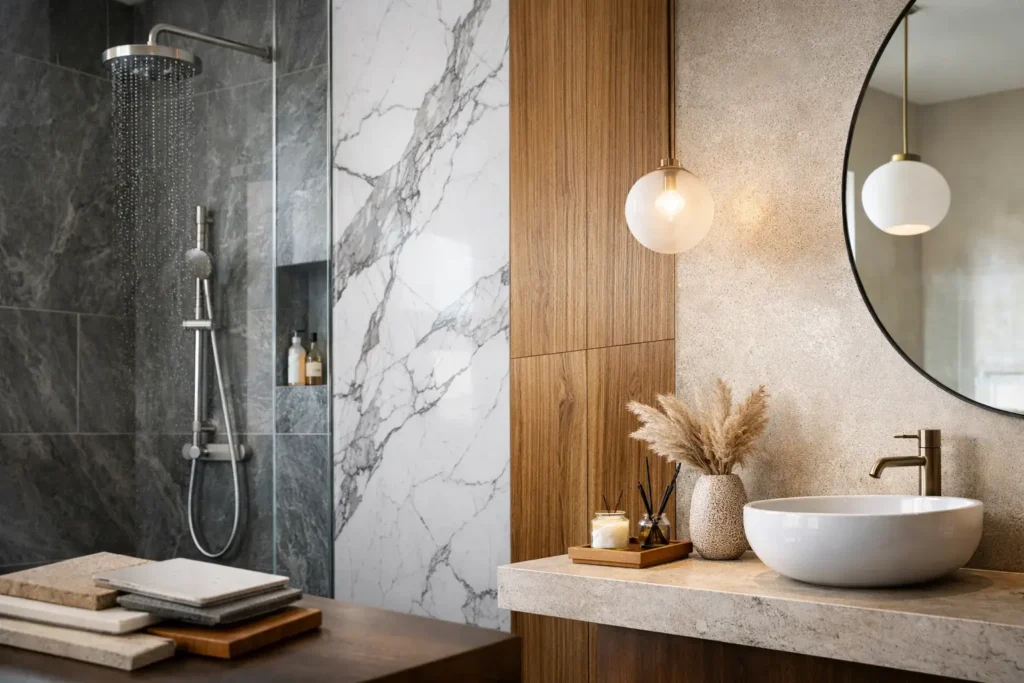
A bathroom wall can look immaculate on handover day and still fail within a few years if the finish is not right for the room’s moisture levels. The best materials for bathroom walls do more than set the visual tone: they protect the structure behind them, simplify cleaning and support the way your household actually uses the space.
For a busy family bathroom, the practical demands are very different from those of a rarely used cloakroom. A walk-in shower needs a fully water-resistant solution and careful preparation beneath it, while walls well away from splashes allow more freedom with texture, colour and character. The strongest schemes balance both.
What makes a bathroom wall material a good choice?
Water resistance comes first, but it is not the only consideration. Steam, ventilation, daily cleaning, hard-water marks and the room’s available light all affect which finish will continue to look considered over time.
A material can be water-resistant without making the whole installation waterproof. This distinction matters most in shower enclosures and around baths. Tiles, for example, need an appropriate waterproof backing system in wet zones, along with correctly finished joints and sealant. Premium materials cannot compensate for poor preparation.
When planning a bathroom renovation, consider the wall in three areas: direct water exposure, occasional splash zones and dry walls. This prevents unnecessary expense while ensuring the places under greatest pressure are properly protected.
Best materials for bathroom walls by finish and function
Porcelain and ceramic tiles
Porcelain tiles remain the most dependable choice for shower walls and high-use bathrooms. They are dense, highly water-resistant and available in an exceptional range of sizes, colours and finishes. Large-format porcelain can create a calm, contemporary surface with fewer grout lines, while smaller tiles bring pattern and detail to a period property or compact ensuite.
Ceramic tiles can also perform very well on bathroom walls and are often more cost-effective. They tend to be easier to cut and lighter to handle, making them particularly suitable for wall applications. Porcelain is generally the better option where maximum durability and low water absorption are priorities.
The trade-off is in the details. Grout lines require occasional maintenance, especially in London homes with hard water, and highly textured or matt tiles can show mineral deposits more readily than a smooth finish. Choosing a quality grout, a sensible joint width and a tile size that suits the room will make cleaning far easier.
Natural stone
Natural stone brings depth that manufactured finishes cannot completely replicate. Marble, limestone, slate and travertine each have distinct movement, tone and tactility, making them a compelling choice for homeowners who want a bathroom to feel more like a refined living space than a purely functional room.
Stone does require commitment. Most varieties need sealing, and some are more vulnerable to staining, etching or changes in appearance over time. Marble, for instance, can be beautiful on walls but may react to acidic cleaners and cosmetics. A honed finish is often more forgiving than a polished one because it disguises water marks and minor surface changes.
Used thoughtfully, stone is particularly effective as a feature wall, vanity backdrop or in a lower-traffic ensuite. It is less suitable when the aim is a completely maintenance-free family bathroom. The key is to choose the stone for its real-life performance, not only for a sample viewed in a showroom.
Waterproof wall panels
Waterproof wall panels offer a clean, efficient alternative to tiles. Available in composite, acrylic and laminate-backed systems, they are installed with very few joins, making them quick to clean and highly practical around showers and baths. Some convincingly reproduce the look of stone, concrete, terrazzo or timber without the sealing and grout maintenance associated with those natural materials.
Panels can be an excellent choice when a bathroom needs to be completed quickly or when the client wants a streamlined, low-maintenance finish. Their large surface area also helps a smaller room feel less busy.
However, quality varies considerably. Lower-grade panels can look artificial at close range or be vulnerable at poorly fitted edges. For a premium outcome, the panel specification, substrate preparation and trim details need to be treated with the same care as tiled work. This is not a shortcut if it is expected to look bespoke.
Microcement
Microcement creates an elegant, continuous surface with a softly textured, architectural appearance. It works especially well in contemporary bathrooms, where it can run across walls, floors and even built-in shelving to make the room feel cohesive. With no grout lines, it is visually calm and straightforward to wipe down.
Its performance depends heavily on application. Microcement is a layered system that needs a stable substrate, disciplined installation and the right protective sealers. Hairline cracking or inconsistent colour can occur if it is applied poorly or over movement-prone surfaces.
This makes microcement a specialist finish rather than a budget option. When properly specified, it delivers a distinctive result that suits luxury living spaces beautifully. When rushed, it can become an expensive remedial job. It is best selected for the look and feel it offers, with a realistic allowance for expert workmanship.
Moisture-resistant paint
Paint is often overlooked, yet it has an important place in a balanced bathroom scheme. A high-quality bathroom paint designed to resist moisture and mould is ideal for ceilings and dry walls outside the splash zone. It offers the widest choice of colour and makes future updates simple, which is valuable if your taste changes or you want to refresh the room before selling.
Paint should not be treated as a substitute for a shower-wall finish. Even specialist formulations are not designed to withstand constant direct water exposure. In the right location, though, it can soften a tiled bathroom, reduce costs and introduce a more personal sense of warmth.
Good ventilation remains essential. If condensation regularly runs down painted walls, the issue is likely to be extraction, heating or insulation rather than the paint itself.
Glass and decorative finishes
Back-painted glass, mirrored panels and specialist decorative surfaces can add light and visual depth, particularly in smaller bathrooms or windowless cloakrooms. Glass has no grout lines and can be made in almost any colour, making it a striking option behind a basin or as an accent wall.
These finishes are usually best used selectively. They can increase the budget, and fingerprints or water spotting are more visible on glossy surfaces. A considered combination – such as porcelain in the shower, painted walls elsewhere and glass behind the vanity – often feels more tailored than covering every wall with one material.
Do not overlook the wall behind the finish
The visible surface receives the attention, but the foundation determines how well it lasts. In wet areas, moisture-resistant boards and a suitable tanking system should be installed before tiling, panels or microcement. Existing walls also need to be assessed for movement, unevenness and signs of previous damp before any finish is selected.
This is where managed renovation makes a meaningful difference. Decisions about pipe positions, niches, lighting, ventilation and tile layout should be resolved before surfaces are installed, not improvised midway through the build. A well-planned wall finish looks intentional because the technical work behind it has been coordinated from the outset.
Choosing the right finish for your bathroom
For a family bathroom, porcelain tiles paired with moisture-resistant paint are usually the strongest combination of resilience, flexibility and value. In a compact ensuite, large-format tiles or quality wall panels can minimise visual interruption and make maintenance easier. For a design-led principal bathroom, natural stone or microcement can create a more bespoke feel, provided their maintenance requirements suit your routine.
Budget should include more than the material price. Large tiles may cost more to handle and fit, stone needs sealing, and specialist finishes depend on skilled labour. Equally, a cheaper finish that needs replacing early is rarely the economical choice. The goal is a bathroom that retains its quality, not simply one that photographs well at the beginning.
A successful bathroom does not need every surface to make the same statement. Choose the most durable material where water is constant, reserve expressive finishes for lower-risk areas, and invest in the preparation that protects both. That approach gives your renovation the quiet confidence of a space designed to serve your home beautifully for years to come.