
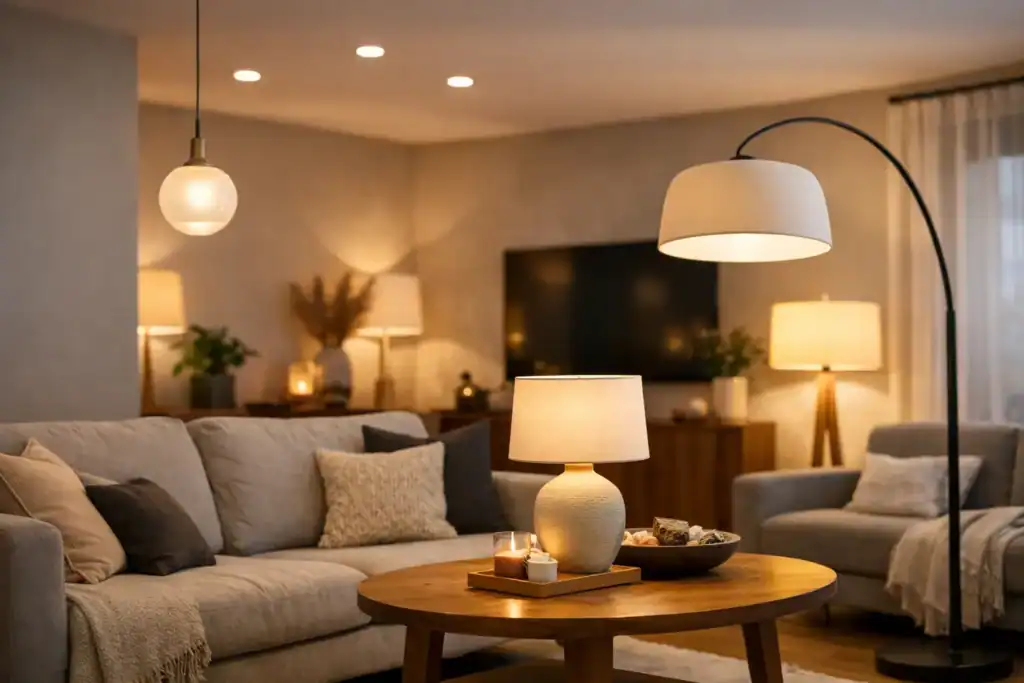
A living room can be beautifully furnished, well proportioned and finished with quality materials, yet still feel flat by evening. More often than not, lighting is the reason. The best lighting for living rooms is rarely a single fitting in the middle of the ceiling. It is a considered mix of light sources that supports how the room actually works – from quiet mornings and family film nights to entertaining guests and making open-plan spaces feel settled.
For homeowners investing in a renovation, lighting deserves the same attention as flooring, joinery and furniture layout. It changes how colours read, how textures feel and how comfortable the room is to use throughout the day. Get it right and the space feels calm, polished and expensive. Get it wrong and even a premium renovation can feel unfinished.
What makes the best lighting for living rooms?
The short answer is balance. A living room needs enough general light to feel usable, enough task light to support specific activities, and enough accent light to create depth. Relying on one type alone usually leads to compromise. A ceiling pendant on its own can feel harsh. Several lamps with no overhead support can leave dark corners. Too many downlights can make a room feel more like a corridor than a place to relax.
The most successful schemes are layered. That means combining ambient lighting for overall illumination, task lighting for reading or hobbies, and accent lighting to highlight shelving, artwork or architectural features. This approach gives you flexibility, which matters even more in modern homes where one room often serves multiple purposes.
It also helps to think about the room at different times of day. In the afternoon, natural light may carry most of the load. By early evening, the room needs warmth and softness. Later on, you may want a lower, more intimate level of light. A well-planned scheme makes those transitions easy.
Start with how the room is used
Before choosing fittings, look at behaviour rather than style. A formal reception room used occasionally needs a different lighting plan from a family living space used every day. If the room is where children play, adults read, guests gather and the television is watched, then each of those functions should inform the scheme.
In many London homes, living rooms also connect to dining areas or kitchens as part of an open-plan renovation. In those cases, lighting has another job: defining zones without making the overall space feel broken up. A pendant over a coffee table, discreet downlights in circulation areas and wall lights near seating can help the room feel organised without becoming overlit.
This is where planning early makes a real difference. During renovation works, cable routes, switch positions and ceiling details can all be tailored to the furniture layout. That is far easier than trying to correct an awkward scheme after plastering and decorating are complete.
Ambient lighting: the foundation of the room
Ambient light is your base layer. It should provide comfortable overall illumination without dominating the room. In some spaces, this comes from a central pendant. In others, recessed downlights are a better fit, particularly where ceiling heights are modest or the look needs to stay clean and contemporary.
There is a trade-off here. Pendants can bring character and visual focus, but they do not always spread light evenly. Downlights are neat and practical, but too many can create a cold, overdesigned effect. For many living rooms, the best answer is restraint – fewer, well-positioned fittings supported by other layers rather than a ceiling crowded with spots.
If you are considering downlights, warm white lamps are usually the safer choice for a living area. Cooler tones can feel clinical, especially against timber floors, soft furnishings and warm paint colours. As a rule, the aim is comfort rather than brightness.
Task lighting: where function meets comfort
Task lighting matters more in a living room than people often expect. A floor lamp beside an armchair can turn an underused corner into a favourite reading spot. A table lamp on a console can soften the room while giving useful light for conversation. If children use the room for homework or crafts, a more focused source may also be needed.
This layer should feel intentional, not improvised. Lamps work best when they are placed to support furniture arrangements rather than added wherever a socket happens to be free. During a renovation, this is worth thinking through carefully. Well-positioned sockets, switched lamp circuits and joinery lighting can make the final result feel considered and easy to live with.
Scale is important too. A small lamp can disappear in a large room, while an oversized fitting may dominate a compact Victorian terrace reception. Proportion should be judged in relation to ceiling height, furniture size and the visual weight of the surrounding finishes.
Accent lighting adds depth
If ambient lighting makes a room usable and task lighting makes it practical, accent lighting is what gives it atmosphere. This is the layer that prevents a space from feeling flat after dark.
Wall lights are especially effective in living rooms because they draw the eye outward and make the room feel broader. Picture lights can elevate artwork. LED lighting integrated into shelving or alcoves can emphasise joinery and create a softer evening mood. In period homes, accent lighting can also help celebrate original features such as chimney breasts, cornicing or wall panelling.
The key is subtlety. Accent lighting should support the room, not demand attention for its own sake. If every niche, shelf and corner is illuminated, the effect can feel busy rather than refined.
Choosing the right bulb warmth and brightness
One of the most common mistakes is focusing on fittings while ignoring the quality of light itself. The bulb you choose affects the mood of the room as much as the fixture.
For most living rooms, warm white light creates the most welcoming result. It flatters skin tones, works well with natural materials and helps the room feel settled in the evening. Brightness should also be moderated. A living room is not a utility space, so the goal is not maximum output. It is controlled, comfortable illumination.
Dimming is one of the simplest ways to improve a lighting scheme. It allows the same room to adapt from daytime practicality to evening relaxation without needing separate fittings for every mood. If there is one upgrade that consistently adds value to a renovation, it is flexible lighting control.
Best lighting for living rooms with different layouts
Room shape has a big influence on what works. A square room often suits a central statement fitting supported by lamps and wall lights. A long, narrow room usually benefits from lighting distributed across the length of the space, so it does not feel bright at one end and gloomy at the other.
Open-plan rooms need especially careful zoning. You may want brighter light near a kitchen or dining area and softer light in the seating zone. Using separate circuits helps each area perform properly while still feeling connected.
Period properties and newer extensions also respond differently. Older homes often suit decorative fittings and wall lights that complement architectural detail. Contemporary rear extensions with large glazing may need lighting that counters the loss of natural light after sunset and softens the harder lines of modern finishes.
Style should follow the architecture
The best lighting scheme always feels as though it belongs to the house. That does not mean every fitting has to match, but there should be a clear relationship between architecture, interior style and light quality.
In a classic London townhouse, ornate chandeliers may suit formal rooms, while simpler wall lights and shaded lamps keep family areas feeling relaxed. In a minimalist renovation, clean-lined fittings and discreet integrated lighting often work better than decorative centrepieces. Mixing styles can be successful, but only if the overall palette still feels coherent.
Material matters as well. Glass, brass, bronze, linen and plaster each change the character of light in different ways. A polished fitting may reflect more glare, while a fabric shade can soften and warm the effect. These details are small, but together they shape how luxurious the room feels.
Why lighting should be planned as part of the renovation
Lighting is often treated as a finishing touch when it should be part of the early design conversation. The reason is simple: good lighting depends on layout, ceiling design, furniture placement and electrical planning all working together.
When managed properly from the outset, you can coordinate socket locations, switching, decorative fittings, joinery lighting and dimmer controls in one coherent scheme. That avoids the common frustration of a beautiful room let down by awkward switch positions or a lack of usable light where it is actually needed.
For homeowners undertaking a full refurbishment or open-plan reconfiguration, this level of coordination is where an experienced renovation partner adds real value. It reduces guesswork, keeps decisions aligned with the overall design, and leads to a result that feels resolved rather than pieced together.
A well-lit living room should not call attention to itself. It should simply feel right the moment you walk in – comfortable, elegant and ready for real life. If you are making changes to your home, treat lighting as part of the architecture, not an afterthought, and the room will reward you every evening.