
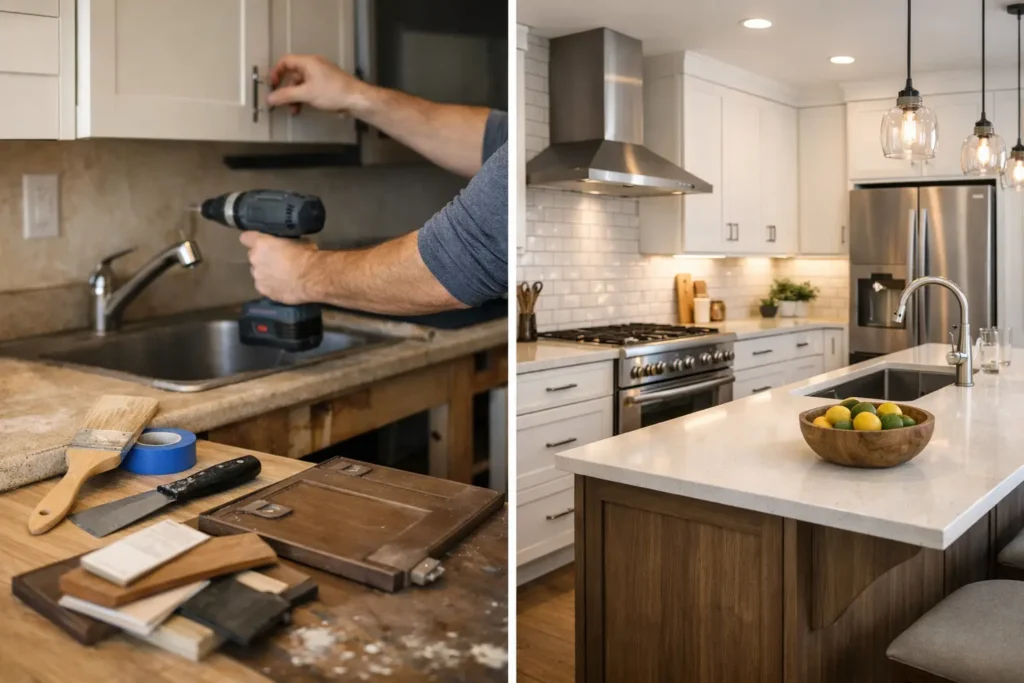
If your kitchen no longer works for the way you live, the question is rarely whether to improve it. The real decision is kitchen renovation versus replacement, and that choice affects your budget, timetable, daily routine and the final feel of your home.
For some households, a well-planned renovation brings the space up to a far higher standard without stripping everything back. For others, full replacement is the smarter investment because the existing layout, storage or build quality is holding the room back. The right route depends on what is behind the cabinet doors as much as what you see on the surface.
Kitchen renovation versus replacement – what is the difference?
A kitchen renovation usually means improving the kitchen you already have. That might involve replacing worktops, upgrading doors and drawer fronts, fitting new flooring, improving lighting, refreshing finishes or making targeted changes to cabinetry and appliances. In some cases, parts of the existing kitchen remain in place while the room is elevated around them.
A kitchen replacement is more comprehensive. The old kitchen is removed, and a new one is designed and fitted from scratch. This often includes a revised layout, new units, updated plumbing and electrics, new appliances and a more complete rethink of how the room functions.
The distinction matters because homeowners sometimes ask for a renovation when what they really need is a replacement. Equally, some assume they need a full new kitchen when a more selective upgrade would deliver the result they want with less disruption and better value.
When renovation makes sense
Renovation tends to be the stronger option when the existing kitchen is fundamentally sound. If the layout still suits your household, the cabinetry is structurally good and the room simply looks dated or lacks refinement, a renovation can transform the space without unnecessary waste.
This is often the case in London homes where a kitchen may have good bones but tired finishes. Replacing worn worktops, improving lighting design, updating splashbacks and introducing better storage details can make the room feel entirely different. The improvement is not only visual. It can also sharpen the way the kitchen works day to day.
Renovation can also be sensible when you are managing cost carefully. A partial upgrade allows investment to go where it matters most. That could mean choosing premium surfaces, better hardware or more considered lighting rather than spending heavily on elements that do not need replacing.
There is also a sustainability argument. If serviceable cabinetry or parts of the existing fit-out can be retained, that reduces waste and avoids replacing materials simply for the sake of starting over.
Still, renovation has limits. If you are trying to work around poor planning decisions from the original installation, cosmetic improvements may only disguise the problem.
Good candidates for renovation
A kitchen is usually worth renovating rather than replacing if the room has a practical layout, the cabinet carcasses are in strong condition and the services are already where they need to be. It also works well for homeowners who want a more polished result without turning the project into a full structural overhaul.
When replacement is the better choice
Replacement becomes the stronger route when the kitchen is no longer fit for purpose. That might mean awkward circulation, too little preparation space, poor storage, failing cabinetry or an arrangement that isolates the cook from the rest of the household.
Many older kitchens were not designed around modern living. Families now often want open-plan flow, integrated appliances, more efficient storage and space that supports cooking, hosting and everyday life in equal measure. If the current kitchen cannot deliver that without major compromise, replacement gives you the freedom to correct the fundamentals.
It is also often the better long-term decision if you are already facing multiple layers of work. Once you start changing electrics, moving plumbing, replacing flooring and altering cabinetry, the cost difference between a major renovation and a full replacement can narrow quickly. At that point, trying to preserve parts of the old kitchen may create unnecessary constraint.
A full replacement also provides more control over quality and consistency. Rather than blending new features into old ones, the entire room can be designed as one coherent scheme, both technically and aesthetically.
Signs your kitchen needs replacing
If doors are misaligned, cabinets are deteriorating, storage is poor and appliances are forcing compromises, replacement is usually the cleaner solution. The same applies if you are planning to knock through into another room or rework the layout to suit a different style of living.
Cost is important, but value matters more
Homeowners naturally start with budget. Renovation is usually less expensive than replacement, but lower upfront cost does not always mean better value.
If a renovation leaves core problems untouched, you may end up spending again sooner than expected. A replacement costs more at the outset, yet it can provide stronger long-term value if it resolves layout issues, improves durability and reduces the need for further work.
The better question is not only what the project costs today, but what it achieves. Does it improve family life? Does it increase functionality? Does it bring the finish level of the kitchen in line with the rest of the property? Does it feel considered enough to last for years rather than just looking fresher for now?
That is where careful planning becomes essential. An itemised quote and a clear scope help you compare options properly rather than making decisions based on headline cost alone.
Disruption, timing and how much change you can absorb
Kitchen renovation versus replacement is also a lifestyle decision. A lighter renovation may mean less time without a functioning kitchen and fewer moving parts during the build. For busy households, that can be a deciding factor.
A full replacement is naturally more disruptive. There is more demolition, more coordination and often more trades involved. If structural changes are included, the timeline extends further. That does not make replacement the wrong choice, but it does mean the project needs to be managed with precision.
This is especially relevant for homeowners balancing family life or demanding work schedules. The less certainty there is around sequencing and communication, the more stressful the process becomes. A well-managed project can make even a substantial replacement feel organised and predictable, while a poorly run minor renovation can still become frustrating.
Design freedom and the result you actually want
One of the biggest differences between renovation and replacement is design freedom. Renovation works within the existing framework. Replacement allows the framework itself to change.
If your goal is to create a kitchen that feels brighter, calmer and more premium, renovation may be enough. If your goal is to introduce an island, improve zoning, conceal clutter more effectively or open the kitchen into a dining area, replacement gives you greater scope.
This matters because homeowners often begin by focusing on finishes when the real frustration lies in how the room functions. Beautiful cabinetry will not fix a cramped layout. Equally, not every kitchen needs to be stripped out to achieve a luxury result. Sometimes the smartest design decision is restraint.
A thoughtful renovation partner will test both routes honestly. That means looking at what can be preserved, what should be upgraded and where a fresh start will produce a more successful outcome.
How to decide which route is right
The most reliable way to choose is to assess the kitchen on three levels: condition, function and ambition.
Condition asks whether the existing elements are worth keeping. Function looks at how well the space works for cooking, storage, movement and family life. Ambition is about the end result you want. If your vision is modest and the kitchen is structurally sound, renovation may serve you well. If your ambitions involve a different layout, higher performance and a more complete transformation, replacement is usually more appropriate.
It also helps to think ahead. Are you planning to stay in the property for years? Are you renovating other areas to a higher standard? Is the kitchen becoming part of a wider open-plan scheme? The more central the kitchen is to your long-term plans, the more worthwhile it can be to make the right structural decision now.
For many homeowners, the best answer comes from a detailed site assessment rather than guesswork. An experienced renovation specialist can identify whether the existing kitchen offers a strong foundation or whether it is likely to limit the project from the start. That level of clarity is where stress starts to fall away.
A kitchen should support the way you live, not force daily compromise. Whether the right answer is renovation or replacement, the strongest results come from choosing a route that fits your home properly, then delivering it with care, transparency and craftsmanship from the very first decision.